
Lam Naraza
Act III
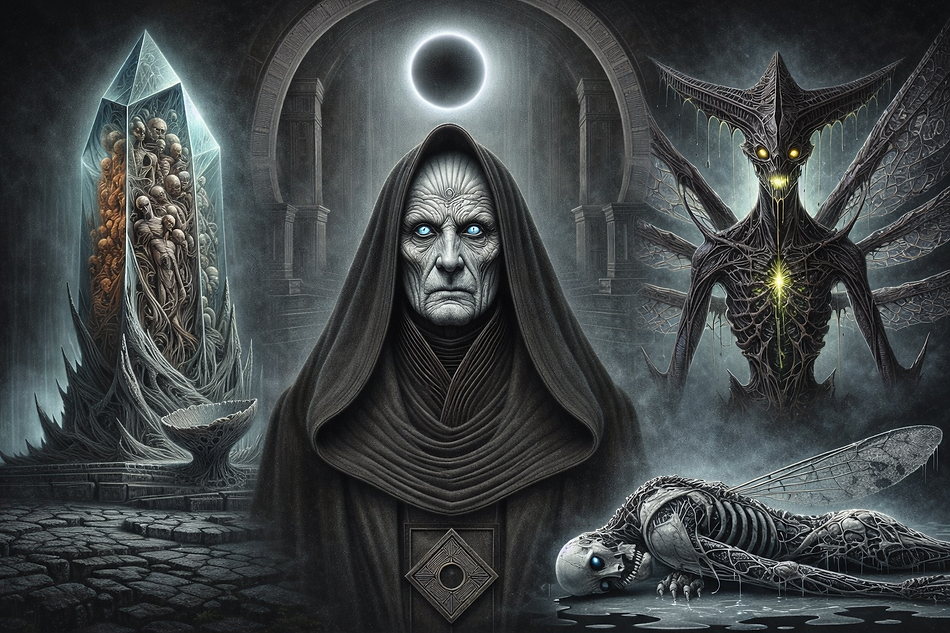
VAEDA
Vaeda’s sleep broke apart in splinters.
Not rest—never rest—but a return. Memory did not come as image alone; it came as pressure, as taste, as the slow constriction of a trap closing on old nerves. She was once more in the belly of the White Sepulcher, that iron-bellied carrion ship which had torn her from Joko’s green resonance and delivered her to the rusted coasts of Morkhul.
Witchbane lay thick on her tongue, a bitter syrup, cloying, chemical. Its alchemy crept through her veins like a slow incendiary, smothering every psionic filament as it burned. Power that should have leapt at a thought instead collapsed inward, stunned. Her limbs became artifacts of flesh—heavy, imprecise things—dragged through a sluggish sea of numbness.
The hold was a theology of despair written in smells: sweat gone sour, old blood drying in the bolt-holes of the deck, the skin-sting of machine oil from the engines. Air moved, but without mercy. Every breath was a negotiation with suffocation. Around her, the other captives voiced their ruin in low, wavering tones. Groans rose and fell, weaving a chant of spent bodies and exhausted hope, braided always with the background thunder of the White Sepulcher’s drives. They were packed in tiered racks and chains, a cargo of sentient meat. Bruises bloomed like dark constellations across starved limbs. Eyes stared past the hull, hollow from having seen too much of human design.
The whip cracked.
Sound came before pain, a sharp line scrawled across the air. The lash followed as wet percussion: leather kissing flesh, flesh answering with a dull, sick report. Vaeda jerked as though the blow had landed on her own back. Memory did that—blurred the borders of skin.
Luthra Crucis moved through the cramped space like a priestess at altar. Aristocratic bones beneath maroon silks, posture refined by generations of ownership. Her smile was an instrument, shaped for cruelty, sharpened on habit. Vaeda felt the iron of the restraints bite deeper into her wrists and ankles as she tensed, chain-links chafing raw flesh. Metal and skin, both designed to hold.
Heat pooled in the hold, thick as breath itself. Grime clung to her like a second hide—salt, soot, blood half-dried in strange geometries across her arms. The screams of others did not remain outside her; they came in, settled under her ribs. She tried to reach for the Shroud, to find that familiar inner architecture of pattern and probability—but witchbane held with the discipline of an old doctrine. Every channel of influence became sealed stone. She was left alone with sensation.
The nightmare broke like a tether cut.
Vaeda surged awake, an abrupt surface-breach into cold awareness. Her heart hammered against the cage of her ribs, counting out the last echoes of the dream. Ship-noise faded. The White Sepulcher fell away. Another sound cut across the phantom roar—measured, precise.
“We must begin our journey to the obelisk,” Yasmina said.
Urgency lived in the Guildmaster’s tone, not in volume but in the clipped economy of her words. “The waters of the Ghost Spring are running dry. Linger here, and this plane will take us into itself.”
An unstable realm, Vaeda thought. A half-finished thought of someone like Ephraxis. A test, or a mistake.
She pushed herself upright. The body she brought with her from the dream still ached, phantom chains leaving phantom bruises along her limbs. The residue of witchbane clung to her nerves, as if the toxin had found a way to cross from memory into waking. She glanced to Noxiel. The psion was already stirring, pale eyes clouded with a weariness that mirrored her own. They shared a brief look—a silent recalibration of two minds accustomed to walking dangerous terrain together.
They followed Yasmina.
The bridge appeared first as a line of light in darkness—then, as they drew near, resolved into impossible architecture. It spanned a chasm that had no visible bottom, only gradients of black that refused definition. The structure’s surface glowed with flickering motes of white, as though stars had been harvested and embedded into stone. Shadows moved along the obsidian walls beside them, not cast by any single source but shifting as if guided by thought.
The bridge defied the implied size of the sphere. Space bent around it in quiet contradiction.
Ephraxis did not build for comfort, Vaeda told herself. He built to make a point.
In the distance, their destination rose: the obelisk. It was an accusation of clarity thrust into ambiguous dark—a vertical shard of crystalline perfection. Across its planes, formulations of the Vox Somnia crawled and reassembled, luminous glyphs moving like living equations, continuously solving and unsolving themselves.
As they approached, awe did not diminish. The construct stood upon a wide platform cantilevered over what seemed an infinite abyss. A dim teal radiance seeped up from the depths, outlining every edge in ghost-light. Within the crystal itself, shapes waited.
Bodies.
They were preserved in a kind of cruel stasis, embedded at varying depths. Faces emerged from the crystal’s interior, mouths open in silent screams, eyes frozen at the apex of terror. Not corpses in the usual sense—more like impressions burned into the material by horror and will. Vaeda felt the psychic pressure of them: a reservoir of hatred and pain crystallized into fuel.
Yasmina halted. Her expression, which usually revealed only what she allowed it to, now showed a strain etched deep across the lines of her mouth.
“These were acolytes of Ephraxis,” she said. “He spent them to shape this sphere and the approach we now walk. Their minds and bodies remain held, suspended at the knife-edge of their last moment. Their suffering feeds the guardian that waits within.”
A doctrine of sacrifice, Vaeda thought. Not an accident. A system.
Her throat tightened. She swallowed hard, tasting ghost-witchbane and spring-water together.
Yasmina retreated a single step, then another, as though feeling invisible teeth at her back. Her hand settled on the hilt of her knife, not to draw it, but to anchor herself.
“I can go no farther,” she said. “Even here, the obelisk hunts me. The path beyond belongs to you, psions. Walk carefully.”
The word psions carried weight in her mouth—part acknowledgement, part warning.
Vaeda and Noxiel advanced onto the final platform. Up close, the obelisk’s scale became almost incomprehensible; it did not merely occupy space, it organized it. A quiet hum of psychic interference brushed against Vaeda’s thoughts, testing, measuring.
At its base sat a stone bowl, carved from the same dark substance as the platform. Etchings encircled its rim: the stylized outline of a hand, drops falling from its palm. In the center of the bowl lay a single barbed needle, stained a deep, dried red that no time or washing had erased.
Ephraxis always demanded an interface, Vaeda told herself. A key. A cost.
Her stomach knotted, but there was no room left for hesitation in the pattern of events. She knew the logic here. Blood bound occupation to structure. Entry required admission.
She drew in a slow breath, steadying her voice. “Be wary of what answers the call,” she said to Noxiel. Warnings were a way of shaping expectation; expectation shaped reaction.
Then she took the needle.
The barb pierced her finger with surgical certainty. Pain flared, clean and sharp, a welcome contrast to the diffuse ache of remembered chains. Blood welled up, dark and thick, gathering at the puncture before falling in lazy drops into the bowl. Each drop landed with a soft, final sound. The liquid pooled, congealing into a viscous, reflective mass.
Pressure descended.
It came not from above, but from all directions at once, the way deep water presses against everything it touches. It thickened the air. Her breath became work. Her thoughts felt the weight of an observing presence.
The obelisk’s pastel luminosity shifted. Colors bled inward, darkening, until the entire monolith burned with a deep, sullen red—an evening sun imprisoned in crystal, radiating a light that did not comfort.
The structure opened.
From the obelisk’s heart, a figure extruded like shadow forced into form. At first it was only an absence, a humanoid outline cut out of surrounding light. Then detail accreted. Limbs elongated. Bone-thin proportions resolved. A bald head took shape, the skull smooth, the face ascetic and skeletal. Translucent insect wings unfurled from its shoulders, each membrane filmed with an iridescent sheen like oil on poisoned water. Black ichor dripped from long, serrated teeth, each droplet hissing as it struck the platform. Yellow eyes ignited—twin embers of calculated malice.
“Shaitan…” Yasmina’s whisper barely crossed the distance, the word not quite a name, not quite a title—more a classification of threat.
The entity surveyed them, gaze moving with slow, mechanical precision, as if cataloging variables. When it spoke, the sound reverberated in the architecture of the sphere itself, a low frequency you felt in bone before you heard it in ear.
“The evil contained herein,” it said, “shall not be loosed upon the galaxy. This masquerade ends.”
A guardian that speaks of containment, Vaeda thought. Not ally. Not simple foe. A node in someone else’s design.
There was no time to follow the thought.
The shaitan’s hand moved in a small, almost casual gesture. Flame answered. It erupted outward in a spiraling column, expanding as it came, a tornado of incandescent heat that turned space itself into a weapon. The inferno rolled toward them, eating light, threatening to erase bridge, platform, psions—everything—in a single breath.
Vaeda acted at the edge where instinct merged with long practice.
She seized the witch-fire poultice at her belt, fingers numb but obedient, and shattered it against the platform at her feet. Viscous alchemical substance met stone, spreading in a quivering pool. Her voice rose into the roar, threading the old syllables of the Vox Somnia through chaos, each sound a lever on unseen machinery.
White fire answered.
It did not merely burn; it took shape. From the blossoming blaze, a vast serpentine form coiled upward—an Elder Wyrm wrought in living flame, its contours outlined in searing radiance. The conjured serpent lunged, carving a path through the onrushing inferno. Abyssal fire met witch-fire and broke, scattered into harmless sparks that fell into the void.
The Elder Wyrm struck the shaitan, wrapping its incandescent coils around the shadow-thing’s frame. Witch-fire clung to that unnatural flesh, seeping into it, setting its very outline alight. Heat rolled off the construct, a cleansing furnace that licked at Vaeda’s skin, and yet she felt strength returning, as though some portion of the fire recognized her as its proper locus.
The shaitan screamed. The sound twisted, part roar, part resonance, its body convulsing as it burned. Even so, Vaeda knew: this was only the first movement of a longer pattern. Guardians born of such sacrifice did not end with a single blaze.
On the platform above the abyss, beneath the red glare of the obelisk, battle had begun—and the sphere itself was listening.
NOXIEL
The whiplash of sensation—red flame and white flame, pain like a hot nail driven through nerve, then the sudden mercy of Vaeda’s weave-craft cooling weave-craft—left the skinthief staggering in a stupor. The blanket of heat thinned and drifted away in shimmering waves. Through the wavering air, the shaitan congealed into view, solidifying like some elder fiend hauled up from a pit older than words. Witchfire still licked its hide, scorching and hissing; acrid tangs invaded Noxiel’s nostrils—burnt fat, charred resin, the iron-sour perfume he could not pin down.
Noxiel loosed his venomous insects.
They came like a thought made swarm—dark wings snapping, bodies swollen and feral, newly magnified by Ephraxis’s macabre artistry. With practiced ease, he donned their skins, distributing himself across a thousand stinging points until his own eyes paled. The puppets felt larger, fiercer—each a sharpened instrument unlike anything found in nature. He drove them up the shaitan’s throat and jawline, swarming its head and neck, delivering a litany of deliberate stings while serrated mandibles carved at flesh like a ravenous sacrament.
The shaitan thrashed and snapped, flinging bodies from itself in twitching arcs of wing and venom, and then it charged—alarmingly fast for something so massive, crossing the deck with predatory momentum that turned distance into nothing.
Noxiel’s hand went to his belt.
With a single telekinetic gesture, he summoned the Verdant Locus and leveled its mouth at the rushing fiend. His voice cracked the air in a hard, ringing syllabary.
“Tharkor Khor’zhul Vesh’serak!”
The box answered with violence. A blinding stream erupted from its crystalline core—an overwhelming bolt of condensed animus—striking the shaitan like lightning made pure. Destructive coils tore through the creature’s form, crawling under hide and into sinew, making its body shudder as if the soul itself were being bludgeoned back into shape.
Noxiel snapped his wasps back into the urn—into safety, into readiness—then lifted his gaze and appraised what remained.
The shaitan, flesh battered, burned, and envenomed, threw back its head and shrieked. The sound pierced Noxiel’s ears like needles, a keening both sharp and lingering. In the wake of that scream, the darkness around the fiend thickened—shadow veins congealing into form, knitting themselves into a two-headed, serpentine hound. Smoke seeped from its elongated necks and from the hollow pits where eyes should have been. This nightmare given flesh wore no fur—only scales slick with night—and each flick of its tongues came with a wet, echoing hiss.
The skinthief drew his simulacrum.
He clutched the doll—its sapphire eyes glowing faintly—and felt the familiar mechanism of the hex click into readiness within his mind, like a trap being set.
“Vaeda!” he barked, voice ragged with urgency. “Distract the hound. The shaitan is vulnerable—but I need time!”
He began to chant furiously in the Vox Somnia, tone by tone, shaping intent into an invisible noose, praying—if such a thing could be called prayer—that the world would hold still long enough for him to tighten it.
VAEDA
Vaeda felt her breath catch as the hound drew itself out of the abyssal fold—a suggestion of bulk at first, then detail: scales, angles, and the distilled intention of killing. It was not simply there; it imposed itself, a correction written into the fabric of the chamber. Twin heads unfolded from the mass, jaws working in a reflex of remembered prey, eyes burning with a predator’s abstract hunger. Around it, the air warped as if reality itself were a membrane forced to admit an intruder it had once rejected.
Her fingers tightened on the needle rifle. The weapon no longer felt like metal and composite; it felt like an extension of a choice already made. Blightbent energies hummed along the barrel, a corrosive resonance that made her nerves sing in sympathetic agitation.
This is what we made of the old poisons, she thought. Sacrament for a different altar.
She drew a calm breath against the hammering of her pulse, leveled the rifle, and aligned the sight with the mass between the two heads.
“Hold on, Noxiel,” she murmured, a growl pitched for her own ears, for the pattern of her fear.
The report cracked through the chamber—sharp, decisive, too small a sound to justify the consequence it carried. The bullet flickered through the air as a thin green streak, a line of intent stitched across space, and vanished into the hound’s scaled hide. Blight blossomed there, a corrosive flower eating inward, its radiance gnawing at shadow-flesh and scale alike.
The beast did not fall.
It roared. The sound was a denial of vulnerability, a raw statement that said: I am still the threat. One head shuddered, half-unmoored, while the other swung toward Noxiel with a terrible, narrowing focus. Vaeda saw the moment of choice in the creature’s gaze, that primitive computation, and felt her own heart lurch in answer as the hound lunged—a blur of claws, fangs, and enforced momentum.
“No!” The word tore itself from her throat, peeled down to panic and purpose.
The jaws closed on Noxiel’s shoulder with a wet, bone-deep crunch. His cry split the air—sharp, human, agonizingly small beside the hound’s bellow. Blood fountained out in a dark arc against the pale radiance of the obelisk, droplets suspended for an instant in the warped air as if the universe itself hesitated over their fall.
Vaeda did not think. Thought, here, was a luxury.
The rifle clattered from her hand, forgotten machinery. Her other hand found the machete at her hip, fingers closing on leather and hilt and memory. The blade slid free—Fatima’s oils still clinging to it in a ghostly sheen, its edge carrying that faint, uncanny hum that spoke of bound spirits and bargains struck in quiet places.
She moved.
Her charge was not reckless; it was a calculated surrender to risk—an equation with no terms left to balance except act. The machete cut the air with a whipcrack hiss, the blade intersecting the hound’s neck in a clean, merciless arc. Resistance came—scale, gristle, the stubborn cohesion of hostile flesh—and then yielded to the will behind the blow.
One head flew free, black ichor spraying in a fan that steamed where it struck the floor.
The remaining head thrashed, jaws snapping in blind outrage, the body staggering under the sudden imbalance. Vaeda pivoted with the motion, letting its own momentum betray it. The second stroke came faster, less a swing than an inevitability. Steel met bone. The edge rode through.
The second head parted from the body.
The carcass collapsed, momentum bleeding away into a boneless sprawl. For a heartbeat, victory felt solid, almost physical. Then the body melted—form loosening into a collapse of shadow, flowing outward as a pool of inky substance that hissed and bubbled as though some deeper engine still worked within it.
From that seething ruin, the counterstroke rose.
Tendrils of shadow uncoiled, thin and vicious, the abstract idea of blades given transient shape. They lashed at her before she could step back—too swift, too many. Pain flared as they scored her arms, her face, cutting through flesh with a heat that had nothing to do with temperature and everything to do with intention. The toxin rode those wounds, a secondary assault, racing her veins as liquid fire.
Her vision smeared at the edges. The chamber tilted, angles no longer behaving as the body expected them to. The deep animal structures in her brain screamed wrong. Nausea surged forward, heedless of dignity or will. She dropped to her knees, convulsed, and emptied the meager contents of her stomach onto the cold, unyielding floor.
Her blood followed. Dark drops pattered into the mess, spreading into small, irregular constellations around her knees. Her hands shook. Her breath came ragged.
But beneath the chaos in her body, she heard it.
Noxiel’s voice.
It threaded through the room like a steady pulse: measured, patterned, each syllable a deliberate footstep on a path she could not see. His chant did not waver, even with his blood on the stone and the hound’s bite burned into his flesh. That sound reminded her of the axis of this moment.
He holds the line in his way. I hold it in mine.
She forced her body to remember standing. First one foot under her, then the other. Her legs trembled as though gravity had grown cunning, changing weight from moment to moment. She refused collapse as one refuses an insult.
“Noxiel… now,” she said, the words scraped raw but intact. It was not a plea alone; it was a signal, a synchronization point between two human vectors in a hostile system.
Her machete was still in her hand. That fact became a point of orientation, a minor truth she could build around. She lifted the blade. The room crackled with latent forces, the air dense with unseen currents, as if the space itself were waiting to discover what it was about to become.
Before them, the shaitan loomed.
Its form was a flickering architecture of malice and memory, never quite settling, like a flame made of overlapping possibilities. Yet its intent was sharp. The yellow of its eyes was not mere color; it was focus, burning down to the core of whomever it regarded. When those eyes locked onto her, she felt the weight of an intellect that had grown in deep, alien contexts—a hatred that had seen civilizations as passing weather.
Her body shook. The toxin gnawed, her wounds burned, her lungs labored. These were facts. There were other facts.
She tightened her grip on the machete until her knuckles whitened. Within her chest, something hardened—not into stone, but into a living resolve, flexible and unyielding in the same breath. Her gaze did not drop. She met the shaitan’s stare and refused the narrative of insignificance it offered.
You are not the only pattern that persists, she thought. We are stubborn, too.
The battle was not finished; its shape had only begun to emerge. But she stood inside it, a chosen point of resistance.
For Baraza, who had made their path possible with his own fractures and wisdom.
For Noxiel, whose voice held the chant steady while blood drained from him.
For herself, the small, defiant locus of choices that had led her here.
Vaeda faced the shaitan, blade ready, fear acknowledged and contained. Whatever came next, she would guard the chanting man behind her to the last breath she owned.
NOXIEL
The pummeled shaitan hauled itself upright—slowly, grudgingly. Vaeda had already slain its shadow-spawn, scattering the two-headed nightmare back into the dark womb that had birthed it; the smoke of its dissolution still lingered in tatters along the floor like breath exhaled by the void. Yet the fiend retaliated with shocking immediacy, given the ruin of its body, as though injury were merely a guise it could shrug off when rage demanded motion.
Its arm transfigured as it charged.
Flesh blackened, lengthened, hardened—bone and sinew re-scripted into a hellish pike, a spear grown from blasphemy. The point hissed with heat and shadow. The distance between them collapsed.
Were it not for the years of psychic conditioning under Baraza’s painstaking instruction—years of humiliation, repetition, and discipline so severe it bordered on cruelty—panic and instinct would have swallowed Noxiel whole. He felt fear surge, yes, but he did not yield to it. He made it serve.
He pronounced each syllable of his weave with surgical precision, attending to every oscillation in pitch and rhythm despite the unremitting pangs in his ruined shoulder. Pain begged him to hurry. He refused. This was not brute force. This was craft. This was the difference between a scream and an incantation.
The shaitan drew nearer, assault imminent—its pike arm already rising, driven by violent intent.
“Rhaakrath Vesh’in!”
On the final word, Noxiel drove a single pin into the simulacrum’s forehead with a decisive, trembling thrust.
“You are mine, creature!” he screamed.
Time stuttered.
Reality seemed to catch on itself, like cloth snagged on a thorn. Patterns surfaced from the ambience—hidden lattices, drowned symmetries—as the Shroud’s geometry heeded the meticulous commands of his will. The air thickened with significance. In that charged instant, a gaze—not mortal, not singular—fixed upon him: Baba Zoku, Serpent of the Hexian Maw, an ancient witch-doctor whose name tasted like rust and grave-dirt.
Noxiel felt the presence like cold pressure behind his eyes.
A decrepit hand—more idea than anatomy—reached beyond the Shroud and seized the shaitan as one might seize a writhing insect. With a dreadful inevitability, it dragged the fiend into a prison of archaic origin, a cage constructed not of iron but indomitable will.
Darkness poured in.
Ethereal mist seeped from stone crevices, luminous and hungry, its pale light feeding on warmth and shadow alike—devouring contrast until the world looked bleached of mercy. Then the floor heaved. Like a sapling not of wood but bone, a sharpened hallucinatory spire erupted upward—sharp it was hungry—and skewered the shaitan through the sternum, pinning it to the obsidian with a macabre finality.
The creature shuddered— impaled, bound, humbled.
With his foe thus subdued, Noxiel darted beneath its neck. He unfurled his psychic talon—a lethal extension of intent—and with a calculated strike, he sliced the shaitan’s throat.
Blood and ichor burst forth, hot and stinging, splashing his robes, his hands, his face—baptizing him in the creature’s ruin. The shaitan’s yellow eyes flared once, then dulled, as if some internal lamp had been snuffed.
The grand illusion—the prison, the spire, the borrowed nightmare architecture—collapsed into ash and fumes. What remained was simple and terrible: their vanquished foe in a broken heap upon the floor.
Noxiel’s strength failed at last. Dangerously fatigued, his knees buckled. His robes hung in tatters, soaked through with blood and brine and sweat. He let the bejeweled simulacrum slip from his fingers. It struck stone with a soft, anticlimactic sound. The sapphire eyes dimmed; their light fizzled away like a doused flame.
The hex had held.
And now it was already becoming memory.
“It is done,” Noxiel declared—though the words felt too small for what had just transpired.
Any joy or relief that might have followed their victory was drowned at once by laughter—bone-chilling, vast, and utterly inhuman.
“Foolish witches…”
VAEDA
Vaeda stood over the fallen shaitan, lungs burning, muscles vibrating on the edge of collapse. Victory lay at her feet like a broken idol—costly, ambiguous, hollow. The sweetness of survival curdled in her mouth as laughter—thin, knife-edged, bone-cold—unwound itself through the vast, crumbling chamber.
A familiar cadence, she thought. But the music is wrong.
“Foolish witches…”
Energy crackled before the obelisk, a whirl of coalescing light and pressure. Yasmina stepped from the distortion—same height, same tilt of the chin—but the pattern was wrong. Her presence rang sour in Vaeda’s senses, as though the Shroud itself recoiled.
With a single, deliberate motion, “Yasmina” tore the lion amulet from her throat and dashed it against the stone. The charm shattered.
Reality shed its disguise.
The Guildmistress’s image collapsed like a discarded veil, revealing an elderly man in hooded robes, black as midnight. His skin held the waxy pallor of something that had lived too long; his lips, gilded and thin, pulled into a smile that understood cruelty as craft.
Behind him, the true Yasmina’s body crumpled to the floor with a sound like empty cloth. Her eyes were pale and sightless, her face set in quiet, obstinate defiance. A woman who had chosen the manner of her defeat, Vaeda thought, but not the hands that delivered it.
Rage and betrayal clenched in Vaeda’s chest like a closing fist.
“Ephraxis, I presume,” she said, the name tasting of iron and old suspicion.
He inclined his head fractionally, golden lips curving.
“Congratulations, witch. You’ve solved the riddle.”
Her grip tightened on the machete. The blade—still slick with the psionic oils Yasmina had provided, the tools of this entire cruel orchestration—suddenly felt like a jester’s prop in her hand. She had followed his vector, trusted his information, walked his path to this moment.
I let him choose the problem, she realized. And now he owns the solution.
“I should have trusted my instincts,” she murmured, grief braided with anger. “Why deceive us? What is it you intend?”
Ephraxis’s eyes gleamed with cold amusement. When he spoke, it was in a measured, chant-like cadence, each line a carefully placed stone in a larger design:
“Psithos learned to breathe with Charybdis long before you suspected; the city exhaled on my signal, a controlled suffocation you mistook for fate. Baraza’s vanity was the single loose thread I required—his vaunted arts, his careful wards, all of it woven neatly into my design until his genius became the lantern that led you to the abyss I had prepared.
Behind the assassin’s borrowed face, it was my will that guided the blade, my whisper that urged you to unmake the warden’s seal and loose what was never meant to sleep. Now Lam Naraza coils where I direct, its coven a single nerve in the body of my intent, and the great houses will discover—too late—that every oath, every alliance, every bastion they trusted now inclines, inexorably, toward my hand.”
Vaeda felt her stomach knot. “The warden?” she asked, though the answer already moved toward her like a closing door.
“Yes,” Ephraxis said, smile unwavering. “The creature you struck down was no shaitan of the Crucible Nexus, but the Archon Soliel—wrapped in a psychic glamour of my own manufacture.”
Vaeda’s gaze tore back to the corpse. The illusion peeled away in slow layers, revealing not a demon but an angelic ruin. White, gossamer blood seeped from torn flesh and broken wings, pooling in fragile strands across the stone.
We murdered a warden, she thought. Not an enemy. A keystone.
The weight of it pressed into her bones. Every motion in the sphere rearranged itself in hindsight—Ephraxis’s guidance, Yasmina’s urgency, the chosen target. They had not merely fought in his game; they were the lever he had needed and could never be himself.
Ephraxis laughed, a sound that scraped along the edges of her mind.
“The Guildmaster invoked the lost Vox Lucis, binding me within my greatest work—such arrogance. I confess, I did not anticipate such a daring counterstroke. Admirable… and futile.” His grin widened, more skull than man. “She wanted vengeance for her son’s murder: a quaint motivation. But Soliel is dead at last, felled by the Lam Naraza’s own hand. Your coven has earned the enmity of the Celestial Fold, witches. An irksome foe.” His eyes hooded. “I should know.”
He turned to the obelisk with a casual economy of movement, fingers dancing across the glyph-panels as though playing an instrument he had designed. Symbols flared, shifted, realigned. A portal irised open: a moonlit throne room revealed itself—polished stone, vaulted shadows, ranks of red-robed disciples waiting in frozen attention.
Ephraxis stepped through the threshold, then paused and glanced back, amusement curling like smoke around his words.
“I thank you for my release, witches. Convey my regards to the abyss.”
The portal sealed with a soft, absolute finality.
The sphere screamed.
A violent pulse of psychic force ripped through the platform, hurling invisible shockwaves across stone and Shroud alike. The air thickened and thinned in jagged alternations, crackling with unstable currents. Fissures spidered through the obsidian walls, glowing at their edges with trapped, frantic light. Chunks of crystal tore free and tumbled into the endless dark below, swallowed by a void that gave nothing back.
Vaeda staggered, then caught herself, eyes locking onto Noxiel.
“We must conjure a portal of our own if we’re to escape!” she shouted over the roar.
She rushed to the base of the obelisk, where the formulae were etched in tight, interlocking spirals. Glyphs layered upon glyphs, logic wrapped in paradox, each line a braided knot of arcane and psionic syntax. She ran her fingertips along the engraved sigils, feeling the hum of equations she could almost—but not quite—grasp.
So this is the true prison, she thought. Not stone. Not the Shroud. Ignorance.
Noxiel limped to her side, his pale eyes raking across the glyphs with a scholar’s desperation. The platform groaned beneath them, shuddering as another section of crystal sheared away into the abyss.
“We’ll find a way out,” he said. His voice did not rise to match the chaos; it held steady, the calm axis in a collapsing world. “We must.”
Vaeda swallowed, mind racing through every discipline she had ever studied, every chant, every construct, every forbidden theorem whispered in Psithos’ deeper halls. The sphere’s collapse was accelerating—the air thinning, the Shroud’s energies spiraling toward some catastrophic reconfiguration: the void pressed in, a physical pressure at her skin, a psychic pressure at her thoughts.
We were pieces on his board, she thought. But pieces can still move.
“Help me,” she whispered, the word more invocation than plea. “We’ll unravel this together.”
Side by side, with the abyss yawning beneath and the Shroud tearing above, the two witches bent over the obelisk’s script—reading, guessing, gambling—against the last seconds of a dying world.
NOXIEL
Ephraxis’s words wounded the skinthief—not merely in pride, but in something deeper and more humiliating: the coven’s journey, already scored by tragedy, was now stained by betrayal as well. The realization landed with sickening clarity: he had played the fool. He had let hope, hunger, and exhaustion conspire against his judgment. Self-loathing pooled in his gut like bile, heavy and hot.
Above them, the black abyss groaned.
Giant debris began to fall—great slabs of marble and obsidian plummeting out of the darkness overhead—sundering the platform beneath their feet as the sphere’s illusions shed themselves like molting skin. The impact of each collapse sent tremors through the stone. Dangerously fatigued from battle, Noxiel fought to keep his footing, boots skidding on ash and blood as the ground pitched and cracked.
He limped to Vaeda.
She stood over the glyphs, hands tracing the formulae with frantic insistence. Her fingers moved in fevered patterns, but meaning refused to unveil itself. Each pass left her just as puzzled—just as stranded—as before. Noxiel surveyed the chamber, his gaze snagging on the dead.
Yasmina lay pinned beneath a chunk of fallen marble, her copper skin gone dull, her fierce discipline reduced to stillness. The sight hit him with a strange, cold practicality. It occurred to him—suddenly, brutally—that the assassin might yet be useful, even in death.
Knotting Yasmina’s hair in his fist, he pulled her head back and opened her skull with a swift psychic slice—clean as a surgeon’s incision. Gore welled and spilled from the ghostly cut, adding fresh carnage to his already ruined robes. His stomach lurched. He fought down the impulse to vomit and failed halfway, retching as his fingers reached for the still, cold brain. The organ sat in his palm with obscene weight—pulpy, texture unforgettable.
“Serak’vesh’in… Thar’inth,” he choked, words half spell, half prayer.
The ritual answered with a hissing crescendo—like breath drawn through a hundred teeth—then darkness folded over him.
He swam through a fractal sea of memories, spiraling impressions and broken scenes, each loaded syllable functioning as a hook and line, guiding him toward the object of his summoning. Faces flashed: a child’s laugh, a dagger’s glint, the teal glow of the Ghost Spring, storms over Obscurum. Then—light blossomed within the dark. A ghostly chorus rose and merged into a single voice.
Yasmina’s voice—familiar, yet made alien by the grave.
“For what purpose do you defile my flesh, witch?” it hissed. “Speak!”
Noxiel swallowed hard against the taste of bile and iron. “Forgive this desecration,” he said, forcing steadiness into his tone, “but the meanings of these formulae elude us. You sacrificed much to learn the sphere’s secret workings. Without your knowledge, we will perish here.” He clenched his jaw. “Help us escape, and I swear justice—for you and for your son.”
Silence followed—an interval long enough to feel like judgment.
Then the spectral voice returned, sharper than before.
“The betrayer lies.” Yasmina’s fury rang through the ether like struck metal. “My son may yet live. He is called Wahid Asan Sayf, and he alone holds the secret to Ephraxis’s final death. Seek him in Exus, on the imperial homeworld of Gul Natha. The Archivist, Samara Tahir, will aid you in your search.”
A pause—tight, terrible.
“Swear it, witch, and you shall have my aid.”
“You have my word,” Noxiel said, and meant it—if only because he had nothing left to trade but promises.
“Very well,” Yasmina’s voice whispered, the anger cooling into command. “The glyphs before you are a mirage. Pay them no mind. Stain them with fresh blood, and the lie will peel away. Beneath, you will find a mural of four characters.”
Her tone shifted, becoming almost ritualistic, as though reciting a key that had once cost her years.
Touch first the shaitan arm’d with sword,
Then wings of fiend in darkness stor’d;
The locust swarm thy third assay,
The flame-touched archon closeth way.
“Then whisper your destination,” she continued. “Visualize it clearly. Your escape shall become plain.” A faint, humorless edge entered her voice. “Take care: voyages through the Gate of Ephraxis can be…jarring. Make haste. And remember—I will hold you to your word.”
The connection snapped. The darkness released him.
Noxiel did not delay.
He flicked his psychic talon across the side of his finger. Blood beaded, then dripped onto the false glyphs. The symbols shuddered, flayed, and bled into something else—an ornate mural of demons and angels, exactly as Yasmina had foretold. He murmured her poem under his breath like a lockpick’s catechism and traced each figure in the prescribed order, finger sliding through slick blood and old dust.
As the trail reached the final symbol, he whispered, “Exus… Gul Natha.”
The air split.
A crackling, elliptical portal swirled into being with a sudden violence that forced him a step back. Wind poured through—crisp and temperate, carrying smoke and savory aromas that struck his senses like mercy: cooking fires, warm bread, distant spice. After rot and brine and witchfire, it was almost enough to make him weep.
“The time has come, Vaeda,” Noxiel said, voice low and urgent. “Let us be rid of this accursed place.”
He set a hand on her shoulder—steadying her, steadying himself. They had endured too many trials since the loss of their Archmagus, and he could already feel the shape of future trials gathering like storm clouds in the mind. Mother Morrigane’s sight remained clouded. Their precious divination poultice was lost to the sea.
And questions—too many—gnawed at him like rats behind walls.
What were Ephraxis’s intentions? What could Yasmina have meant by the betrayer’s final death? Did Wahid truly live? What part, if any, did Ephraxis play in Morrigane’s prophecy? Would the Celestial Council seek vengeance for the murder of Soliel?
Such questions demanded answers. Somewhere beyond this threshold waited new enemies in realms far wider than their old maps had conceived. A reckoning felt inevitable—looming, patient, already in motion.
But for the moment, the witches needed rest.
Noxiel could not be certain what lay ahead. He only knew he ached for sunlight that did not lie, and for a real meal that did not taste of weave-craft. Alongside the blightbender, he stepped through the portal—leaving the conjuring sphere behind, abandoned to the oblivion it deserved.